 |
| rockpapershotgun. (n.d) https://www.rockpapershotgun.com/images/16/mar/rust4.jpg |
Rust, as with many online games, is a mix of game and social network. It blurs the line between space and place and elicits innumerable aspects to study. If power is all relational, then understanding the framework where the relations take place is a logical place to start. The focus here is on unpacking how the framework of the game creates unequal power distribution before a match even starts.
In order to play Rust, the player has to choose from a list of servers with a maximum of 128 players in any one server. Each server is a separate world for players. However, these servers are reset every week or month, creating a time limit to how far a player can progress with each play-through. Further complicating the notion of progression, Rust is a sandbox game without a leveling system. There is no pre-defined end goal. Rust never requires you to be social despite the presence of other players. In some servers it may be hard to even encounter other players, in others players are everywhere.
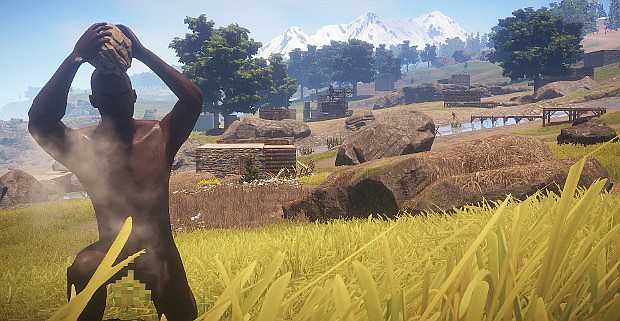
Every player starts with the same character (gender aside, which deserves its own essay), the primary variable is where on the map a player spawns. On the surface, this is egalitarian. However, if we take into account Bourdieu’s forms of capital, the inequality of the situation is observable: any player starting the game without a prior knowledge of how to play (cultural capital), without a clique (social capital), and at any point in time other than at the commencement of a fresh server (economic capital), already lacks a form of power that another player might have (Bourdieu, 1979).
As in many networks, the random spawn point on the map and seemingly equal beginnings give rise to certain conventions which those with more power exploit. In a comical example of Allen’s modalities of power, a video made by youtube user SovietWomble shows the narrator using manipulation and coercion to trick other players into thinking he is a new player to lure them out of their base with tragic consequences (Allen, 2003). The betrayal is only possible because all players of Rust have an understanding of what it is like to be the new player and want to either help them or loot them depending on their disposition.
The power relations of Rust in many ways reflect those of the physical world. Power is not a linear scale that starts with everyone equal. It is nebulous, subtly and obviously permeating every crevice of a networked society. It can be the brutal authority of a fired gun through to mere geography in the case of randomly spawning next to advanced players. Power is everywhere, and especially in a game like Rust, egalitarianism isn’t equal.
References
Allen, J. (2003). 'Introduction: Lost Geographies'. In Lost geographies of power. (p.p. 1-12). Malden, USA: Blackwell Publishing.
Bourdieu, P. (1979). Ideas of Cultural Capital. In (Kuttainen, V. (2017) BA1002: Our space: Networks, narratives and the making of place, lecture 3: Power. [PowerPoint slides]. Retrieved from http://learnjcu.edu.au
[SlayingWorld]. (2016, January 16). Rust Amazing/Heartbreaking Betrayal! [Video file]. Retrieved from https://www.youtube.com/watch?v=DVFbotpDVCA
rockpapershotgun. (n.d.). Rust4 [Image]. Retrieved from https://www.rockpapershotgun.com/images/16/mar/rust4.jpg

No comments:
Post a Comment